
Forehead–Eyebrow Lifting (Browlift)

As time passes, all the tissues of the body undergo changes collectively referred to as aging. The effects of aging are particularly visible on the face, where the skin becomes thinner, loses its elasticity and firmness, and becomes lax, and due to gravity all facial structures tend to descend.
The first signs of aging often appear on the forehead and eyebrows, where wrinkles form as a result of laxity, while the eyebrows “drop” due to gravity, giving the face a tired and sad appearance.
What is forehead lifting or brow lift?
Forehead lifting, or brow lift surgery, is the procedure that restores the appearance of the upper part of the face. It corrects drooping eyebrows and improves horizontal forehead wrinkles. It can be performed alone or, more commonly, combined with other facial procedures such as a facelift or blepharoplasty for comprehensive facial rejuvenation.
Am I a suitable candidate for forehead lifting?
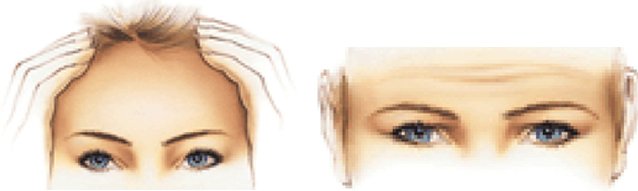
Forehead lifting is usually performed between the ages of 40–60 to improve signs of aging in the upper third of the face. However, it can help patients of any age who have pronounced forehead wrinkles and low or “drooping” eyebrows. An easy way to preview the potential result of forehead lifting on your face is to place your hands above the eyebrows and at the sides of the eyes and gently lift the skin upward.
How is forehead lifting performed?
Forehead lifting can be performed using various surgical techniques, each suitable for addressing specific problems. In most cases, the procedure is performed under general anesthesia, although sedation with local anesthesia may also be used.
The three main techniques applied are:
- the classic or open forehead lift,
- the minimally invasive forehead lift, and
- the endoscopic forehead lift.
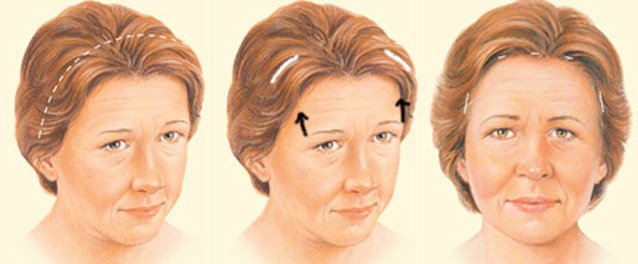
The main difference between these techniques lies in the location and size of the incisions used, as well as the extent of correction that can be achieved.
In the classic or open forehead lift, an incision is made at the top of the scalp, from one ear to the other, hidden within the hair. Through this incision, the muscles that cause forehead wrinkles are cut or cauterized at various points, excess skin is removed, and the eyebrows are lifted, giving the forehead a smoother and more youthful appearance.
In the minimally invasive forehead lift, a small incision (4 cm) is made in each parietal area high within the hairline. Through these two incisions, the eyebrows are lifted to the desired position, but only a minimal amount of skin can be removed. Internal sutures are usually used to maintain the result.
In the endoscopic forehead lift , 3–4 incisions of approximately 1 cm are made within the hair. An endoscope and specialized instruments are inserted through these openings to improve forehead wrinkles and elevate the eyebrows. The endoscopic technique has the advantage of requiring very small incisions; however, due to its nature, it cannot achieve dramatic results.
What should I expect after surgery?
The postoperative course differs significantly between patients who undergo an open forehead lift and those who undergo minimally invasive or endoscopic techniques. The procedure lasts 1–2 hours and, as mentioned, is usually performed under general anesthesia. Hospital stay is not typically necessary but is recommended for better postoperative monitoring.
After a classic or open forehead lift, significant swelling and bruising may appear on the forehead and may extend to the eyelids and cheeks. It is recommended to keep the head elevated above the rest of the body when lying down for 2–3 days to reduce swelling. The use of cold compresses may also help. Initially, numbness around the incision and mild pain may occur, which are managed with common analgesics. As the cut nerve endings begin to recover, pain may be replaced by itching. These sensations may last for several months until they fully subside. Sutures are usually removed one week after surgery.
With the less invasive methods, swelling and bruising are much more limited and the overall recovery is significantly milder.
When can I resume my normal activities?
Recovery time varies from person to person and largely depends on the extent of the procedure performed. Showering and hair washing are permitted after 1–2 days, while the use of make-up is allowed after three days. Avoid intense physical activity, deep bending, and heavy lifting during the initial recovery period. Return to light activities is expected within 7–10 days. However, strenuous exercise should be avoided for several weeks. Also avoid sun exposure during the first weeks after surgery, and in general protect your skin with a good sunscreen.
To book an appointment, please contact us.