

Abdominoplasty (Tummy Tuck)

The presence of a large, sagging abdomen is a common concern for both women and men. The causes of this condition are varied and include obesity, weakening of the abdominal muscles, pregnancy, skin laxity, major weight loss, and more.
The result is almost always the same: accumulation of fat in the lower abdomen, protrusion of the abdominal wall, loose skin with unsightly folds, and the appearance of stretch marks due to loss of skin elasticity.
What is abdominoplasty?
Abdominoplasty is a procedure designed to restore the natural contour of the abdominal wall by eliminating excess skin folds, tightening the abdominal muscles, and improving stretch marks located on the lower abdomen. It may involve the entire abdominal wall (classic abdominoplasty), be limited to the lower central abdomen (mini abdominoplasty), or be combined with liposuction (lipoabdominoplasty).
When is abdominoplasty performed?
Abdominoplasty is commonly performed in middle age, after multiple pregnancies, following massive weight loss, or due to skin laxity, but it can be done at any age when the problem occurs.
How is abdominoplasty performed?
The procedure is carried out under general anesthesia or epidural anesthesia with sedation and lasts approximately 2 to 2.5 hours.
In a classic abdominoplasty, an incision is made between the two hip bones just above the pubic area, along the so-called “bikini line,” where it is hidden by underwear or swimwear.
The skin and fat of the lower abdomen are then elevated up to the level of the navel. An incision is made around the navel so that it remains in its original position, and the dissection continues upward to just below the ribs.
The abdominal muscles, which have become lax, are tightened and sutured together along the midline, restoring the strength of the abdominal wall and refining the waistline.
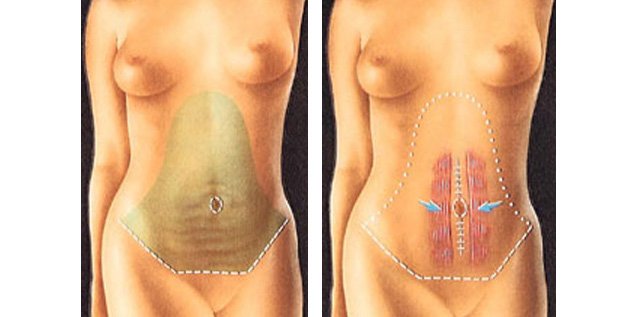
Finally, the excess skin and fat — along with the stretch marks below the navel — are removed. The belly button is brought out through a small incision, and the skin flap is pulled downward and closed with internal absorbable sutures. Two small drains are usually placed on each side and remain in place until fluid production stops (typically 24–48 hours).
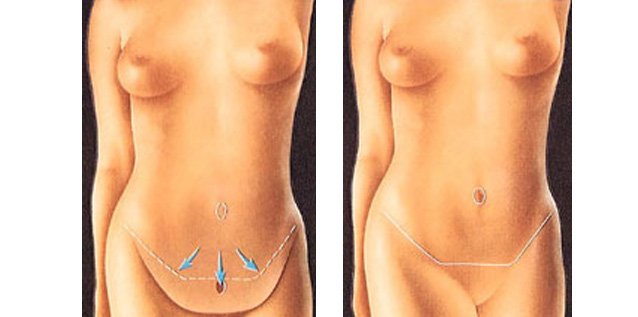
In “mini abdominoplasty“, the incision is smaller, and the dissection of the skin and fat extends only up to the navel. Excess skin and fat are removed, and the area is tightened with internal absorbable sutures.

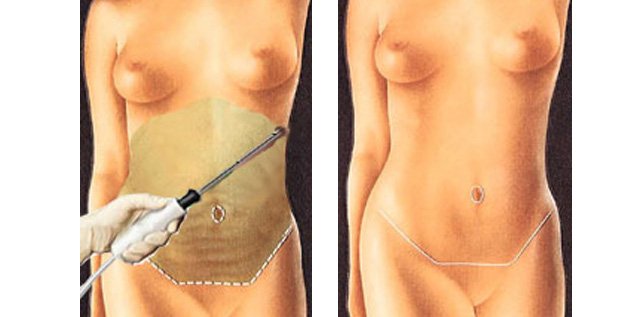
In lipoabdominoplasty, extensive liposuction of the abdomen and waist is performed first, followed by abdominoplasty. However, the skin flap is not lifted as high as in classic abdominoplasty, allowing for improved overall contouring of the torso.
What should I expect after surgery?
The procedure lasts approximately 2–2.5 hours, and you will usually remain in the clinic for 1–2 days. Pain is generally mild to moderate and is managed with oral or intravenous pain medication.
On the day of surgery, you will mostly rest in bed with your legs slightly bent. From the following day, you will begin walking short distances. Drains are typically removed after 24–48 hours.
For the first few weeks, you will need to wear a supportive abdominal garment to help the abdominal wall heal and to prevent fluid accumulation beneath the skin.
The sutures are usually internal and absorbable, so no removal is needed. Scars are initially red and slightly firm but gradually soften, turn pink, and eventually fade, leaving a fine scar hidden by underwear or swimwear.
When can I return to my activities?
During the first week after surgery, you should remain at home with limited activity. Walking is encouraged, but household tasks are not permitted. From the second week onward, you may gradually increase your activity level, and after two weeks you may return to light work. Full return to normal activities is expected after 4–6 weeks.
For mini abdominoplasty, recovery typically takes only 1–2 weeks.
To book an appointment, please contact us.