

Eyelid surgery (Blepharoplasty)

The eyes are the central feature of the face and play a major role in facial expression. Their appearance is greatly affected by excess skin, wrinkles, and under-eye bags, which give the face a tired and sad look.
Natural skin aging leads to eyelid laxity, the formation of folds and wrinkles, and the development of puffiness—particularly in the lower eyelids. The problem often appears more pronounced in the morning due to fluid accumulation in the already loose tissues. In some patients, there is a genetic predisposition, causing laxity to appear at a much younger age than expected.
What is blepharoplasty?
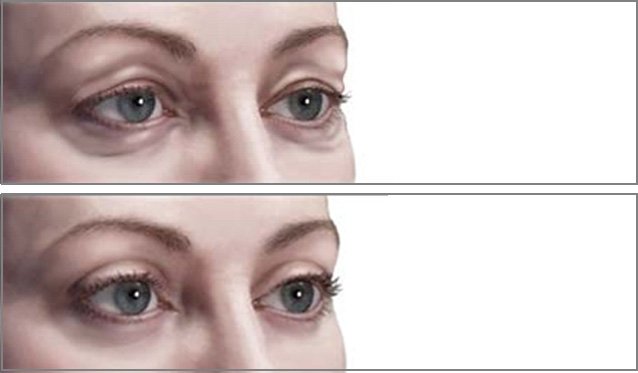
Blepharoplasty improves facial expression and gives the face a more youthful and refreshed appearance by removing excess skin and fat. It cannot correct “crow’s feet” wrinkles or completely eliminate dark circles around the eyes (although these may often improve). Blepharoplasty can be combined with other facial procedures such as facelift or brow lift.
At what age is it performed?
Blepharoplasty is usually performed after the age of 35–40, when laxity becomes more noticeable, but it can also be performed at a younger age (20–30) if there is a hereditary predisposition.
How is it performed?
The procedure is usually carried out under local anesthesia with mild sedation and lasts approximately one and a half hours.
For the upper eyelids, the incision is made within the natural crease, about 1 cm above the eyelashes. Excess skin and fat are removed, and very fine sutures are placed.
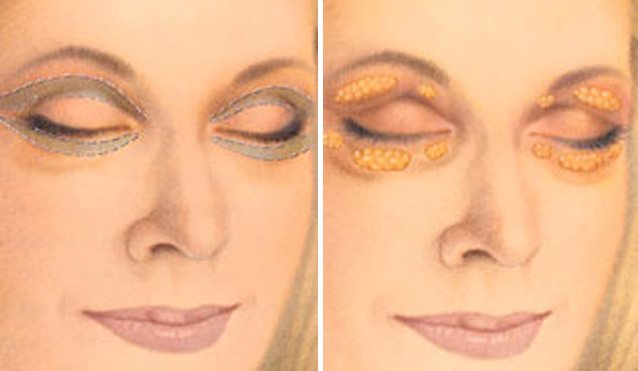
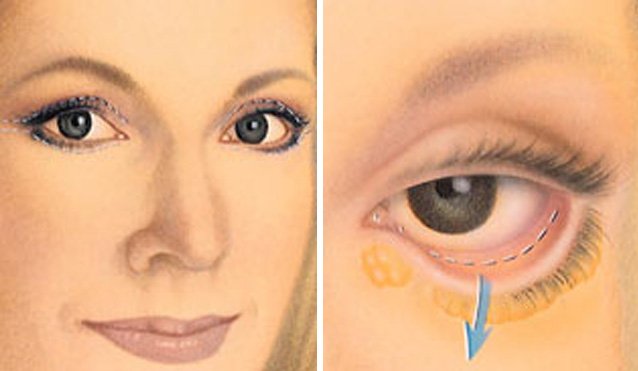
For the lower eyelids, the incision is usually made just below the eyelashes. Through this incision, excess skin and fat are removed, or sometimes the fat is repositioned, and the septum that holds the fat in place is reinforced. The incision is closed with very fine sutures. In some cases, small amounts of fat from another area of the body may be added to areas that appear hollow, to achieve a more youthful look.
In other cases, if there is no excess skin at all, the incision may be made on the inside of the lower eyelid (transconjunctival approach). In any case, eyelid scars are typically barely noticeable.
What can I expect after surgery?
Immediately after the procedure, cold compresses are applied to reduce swelling and bruising, and you can usually return home within 1–2 hours. During the first 24 hours, it is recommended to rest in bed with your head elevated while continuing the cold compresses. Pain is typically very mild (more like a feeling of pressure) and is easily managed with simple pain relievers such as paracetamol (aspirin should be avoided, as it may cause bleeding).
Swelling is usually most intense during the first 48 hours and then gradually subsides over the next 5–7 days, while bruising typically fades within 7–10 days. The stitches are removed 3–5 days after surgery, at which point makeup can be used again.
During the first few days, you may experience mild light sensitivity, increased tearing, or, conversely, dryness. These symptoms are easily managed with eye drops and usually resolve within 1–2 days.
When can I return to my activities?
Strenuous physical activity and bending should be avoided for the first 4–5 days. Contact lenses should also be avoided for 7–10 days. Most patients return to work within 3–4 days, while full return to normal activities is expected after about two weeks.
To book an appointment, please contact us.