
Hair loss treatment with PRP

Autologous mesotherapy with platelet-rich plasma (PRP), as it is scientifically known, is an innovative treatment that utilizes the body’s own regenerative and healing properties to rejuvenate the skin and stimulate hair follicles.
Platelet-rich plasma (PRP) has been successfully used in the treatment of hair loss since 2009, pioneered by Dr. Greco in the United States and Drs. Amgar and Bouhanna in France.
What is autologous mesotherapy?
Autologous mesotherapy with PRP is an injectable treatment in which, instead of medications or external active substances, growth factors derived from the patient’s own blood are used to rejuvenate hair follicles and stimulate hair growth.
How does PRP work in the treatment of hair loss?
The theory behind PRP therapy is based on the action of platelet growth factors, which activate adult stem cells in the scalp as well as the cells of the hair follicles, while also increasing the vascular network surrounding the follicles.
These effects slow down hair loss and strengthen existing hairs, resulting in thicker and healthier-looking hair.
Which types of hair loss can be treated with PRP?
The treatment is effective in androgenetic alopecia, female-pattern androgenetic alopecia, and alopecia areata as a second-line therapy when steroids and other first-line medications have not produced the desired results. It is also used in cicatricial (scarring) alopecia, where PRP appears to help regulate the skin mechanisms that lead to scarring, while potentially stimulating hair follicle stem cells that have not been destroyed by the scarring process.
Finally, PRP therapy is used adjunctively during hair transplantation, where it appears to significantly increase graft survival rates.
How many sessions are needed?
Different research groups use their own treatment protocols; however, in general, androgenetic alopecia typically requires two sessions spaced two months apart, followed by maintenance treatments every 6–12 months.
For alopecia areata, three sessions are usually required, also spaced two months apart, while for cicatricial (scarring) alopecia, two to three sessions are recommended at two-month intervals.
How is it performed?
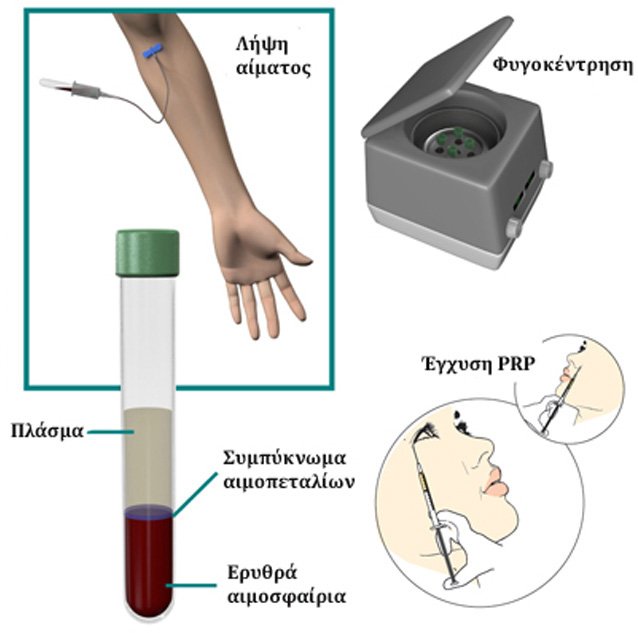
The procedure is very simple. A small amount of blood is drawn from the patient, similar to a routine blood test, and processed through centrifugation to isolate plasma rich in platelets.
The platelets are then activated with calcium ions to release their growth factors, and the PRP is injected into the scalp using a very fine needle.
Is the treatment painful?
The procedure is nearly painless due to the use of extremely fine needles. For patients who are particularly sensitive, local anesthetic cream may be applied to fully numb the area.
How long does the treatment take?
The entire session lasts approximately 1 hour and 15 minutes, including the time needed for the anesthetic cream to take effect. The actual injection time is about 20–30 minutes.
Are there side effects?
PRP therapy has no significant side effects, as it is completely natural. Since it is derived from the patient’s own blood, it contains no foreign substances that could trigger allergic or adverse reactions.
To book an appointment, please contact us.